Aleksandr Solzhenitsyn

Through the power of his words, Aleksandr Solzhenitsyn helped change the world. He wrote about Russia, the country in which he was born and where he died. He won the Nobel Prize for Literature. His writings helped bring about the downfall of the Union of Soviet Socialist Republics (USSR or Soviet Union), which began and ended in his lifetime. But surprisingly the place where he lived the longest, and where he was the most productive, was Cavendish, Vermont.

Aleksander Solzhenitsyn lived from 1918 to 2008. The 100th anniversary of his birth is being celebrated in Vermont this year. Who was this man and what did he do? And what was his connection to Vermont?

Continue reading

Posted in General | Tagged | Leave a comment

Illusion of Explanatory Depth

Zac Mayo introduced me to the concept of the “illusion of explanatory depth” (IOED):

Most people feel they understand the world with far greater detail, coherence, and depth than they really do.

For example, how well do you feel you understand how a refrigerator works? Try explaining it to a friend or on paper and then consider the question again.

The phrase IOED was coined in a 2002 paper by Leonid Rozenblit and Frank Keil of the psychology department at Yale University. Zac found the idea online at Edge.org.

Continue reading

Posted in General | Tagged | 1 Comment

2008 Financial Crisis: What can we learn?

Financial markets crashed ten years ago. See my previous post for what happened and comments about the graph to the left. This post is about lessons that we can learn from that crisis.

What caused the 2008 financial crisis? People who are skeptical of unbridled capitalism will highlight mismanagement, greed, and fraud in financial institutions, and there was some of that. People who are skeptical of too much government will highlight perverse incentives in certain laws and government institutions, and there was some of that, too.

This post is about two different causes: debt and models.

Continue reading

Posted in General | Tagged | Leave a comment

2008 Financial Crisis: What happened?

Financial markets crashed ten years ago. What happened? If we are to learn from the past, we must first remember the past.

In September 2008 I was the CEO of a financial institution – Yankee Farm Credit, part of the national Farm Credit System. I had worked for Farm Credit for 24 years and I had been CEO for 2 years. Yankee Farm Credit was small ($320 million in assets at the time), but the Farm Credit System in total is a large financial institution ($186 billion then).

Ten years ago today two large financial institutions failed. These institutions were not typical financial institutions. They were a certain type of financial institution known as Government Sponsored Enterprises (GSEs). There are only four significant GSEs in the United States. The Farm Credit System is a GSE. This financial crisis had my attention.

Continue reading

Posted in General | Tagged | Leave a comment

Free Speech Pioneers

Matthew Lyon was the first person to be fined and imprisoned under the Sedition Act of 1798, one of four federal laws passed that year known as the Alien and Sedition Acts. His crime: public criticism of President John Adams that was deemed seditious.

Lyon was a member of the U.S. House of Representatives from Vermont. His conviction in October 1798 came near the end of his first term. Vermonters overwhelmingly re-elected Lyon to a second term, and to this day he remains the only person elected to Congress from jail.

Anthony Haswell was a printer in Bennington, Vermont, and publisher of the Vermont Gazette newspaper. His publications in his newspaper in support of Lyon incurred the wrath of federal authorities, and Haswell was also arrested, tried, convicted, imprisoned, and fined under the Sedition Act. When his prison term ended, a crowd of 2,000 people gathered in Bennington to celebrate his release.

This post is about three pioneers of free speech: Anthony Haswell, Matthew Lyon, and Ethan Allen. Ethan Allen?? Yes, read on.

Continue reading

Posted in General | Tagged | Leave a comment

Bennington Battle Day

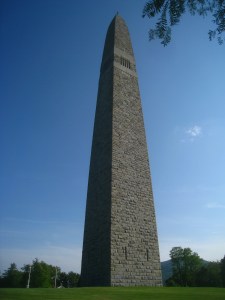
Today is a state holiday in Vermont – Bennington Battle Day, commemorating the Battle of Bennington in the American Revolution on August 16, 1777.

The year 1777 was a pivotal year in our history.

For Vermonters, that was the year we declared ourselves an independent republic, six months after the Thirteen Colonies declared themselves to be “free and independent States.” For our country, that was the year that the American Revolution turned in our favor. The Battle of Bennington was “the turning point that led to the turning point.”

Continue reading

Posted in General | Tagged | Leave a comment

Zac Mayo for House

Today I submitted the following letter to the editor of the News & Citizen:

Cambridge and Waterville are fortunate to have two fine young people running for the open position in the Vermont House created by Bernie Juskiewicz’s decision not to run for re-election. I have visited with both Lucy Rogers and Zac Mayo and I am impressed with their character, intelligence, energy, and humility.

In visiting recently with Zac, I was pleased to find that he is intellectually curious, a seeker of multiple viewpoints, a good listener, and an independent thinker. He talked about his quest to understand our country subsequent to the 2016 presidential election, and his desire to improve the state of our political discourse. His views about the appropriate role of government in our society comport well with my own views. (I want good government, but not necessarily more government.) Zac’s years of service in the Navy taught him about people and organizations, which will serve him well in Montpelier. For all of these reasons, I am supporting Zac Mayo for the Vermont House.

The contest between Zac and Lucy has been positive, which has renewed my faith in our ability to govern ourselves. Other political campaigns, mostly by candidates of my generation, have sometimes led me to question that faith. But if Zac and Lucy are representative of their generation, our country will be in good hands. Thank you, both Zac and Lucy, for your interest and participation in our grand American experiment in self-government.

Posted in General | Tagged | 2 Comments

Open Meeting Law

This post is part of a series of posts on “Learning about town government” in my town of Cambridge, Vermont. Please see the link for context, a disclaimer, and a list of posts in this series.

This post is about Vermont’s open meeting law.

In the United States, every state and the federal government has some form of “sunshine” laws intended to create transparency and accountability in government, i.e., that government “operates in the sunshine.” Sometimes these laws are called “freedom of information” laws. These laws usually have two aspects: citizen access to government meetings and citizen access to government records. In Vermont, these laws are called the Open Meeting Law (OML) and the Public Records Act (PRA). This post is about OML.

OML applies to town government as follows: all official town boards, commissions, and committees, including subcommittees (called “public bodies”) are subject to OML. For example, OML applies to the selectboard. OML does not apply to individual officials. A meeting of the town clerk with other individuals does not come under OML (unless those involved constitute a quorum of a public body).

Following are the main points of OML:

  • Meetings of public bodies must be open to the public. That is, the public must be allowed to attend meetings to watch and listen. The law allows for limited exceptions, such as contract negotiations and certain employee matters.
  • Meetings must allow a “reasonable opportunity” for public input on matters being considered by the public body. The chair is charged with running an orderly meeting.
  • Agendas must be prepared for all regular and special meetings of the public body, and posted at least 48 hours prior to a regular meeting and at least 24 hours prior to a special meeting.
  • Minutes must be taken at all meetings, and posted not more than five calendar days after the meeting.

Those main points of OML seem straight-forward enough, but they are qualified by two important considerations:

First, with very limited exceptions, any gathering of a quorum of a public body for the purpose of discussing the business of the public body, or for the purpose of taking action, is considered a “meeting” that must satisfy all of the above requirements. The Vermont Secretary of State advises that this includes discussions by any means (e.g., email, telephone, etc.), not just physical gatherings, even if those discussions are spread out over time (e.g., an email chain over several days). Group emails can easily constitute a “discussion” that is problematic under OML. The issue with such discussions is that they do not meet all of the above requirements. It is likely that such discussions do not meet any of the above requirements.

Second, the authority of any public body is a group authority. Authority is delegated to the group, not to any individual. A public body may exercise its authority only by acting as a group in a proper meeting – meaning that a meeting is held that satisfies all of the above requirements, a quorum is present, and there is a majority vote. An individual member of the public body has no special authority unless specifically authorized by law or action of the public body. A public body may delegate some of its authority to an individual, but it may do so only by acting in a proper meeting where that action is recorded in the minutes.

The goal of Vermont’s open meeting law is transparency and accountability in government, which is desirable. However, taking all of the above into account, OML has implications for the ability of public bodies in town government to be effective. Perhaps someday I’ll write more about that, but for now I’ll simply note the following aspect which relates to the theme of this series of posts (learning about town government) especially for new selectboard members. With the current 3-member selectboard in Cambridge, a quorum is two. No member of the selectboard may talk with any other member of the selectboard about anything to do with town business outside of a public meeting. (There are very limited exceptions to this rule.) Regular selectboard meetings in Cambridge are twice a month for about two hours at each meeting. That is not much time, and meeting agendas are full. This restriction on discussions between selectboard members not only limits how much and how quickly things can be done, but it also makes it difficult for a new selectboard member to learn the job. This situation will change with the expansion of the Cambridge selectboard to five members at the next annual town meeting on March 5, 2019. Then a quorum will be three, and it will be possible for a new selectboard member to visit with a veteran selectboard member in a 2-person conversation, outside of a public meeting, to learn the job.

There are many more details to OML than I have summarized above. OML is complicated, and the legislature is constantly tinkering with it. Both OML and PRA are found in 1 V.S.A Chapter 5. OML is in Subchapter 2 (§§ 310-314) and PRA is in Subchapter 3 (§§ 315-320).

For more information about “sunshine” laws in the United States in general, see this Wikipedia article:

Freedom of information in the United States

Click here to go to the initial post in this series: “Learning about town government.”

Posted in General | Tagged , , | Leave a comment

Dillon’s Rule

This post is part of a series of posts on “Learning about town government” in my town of Cambridge, Vermont. Please see the link for context, a disclaimer, and a list of posts in this series.

This post is about Dillon’s Rule.

In general, what are the rights of a town to govern itself? In the United States, different states answer that question differently. Two ends on a spectrum of possible answers to that question are Home Rule and Dillon’s Rule:

Home Rule: The town may do anything that is not prohibited by federal or state constitutions or law.

Dillon’s Rule: The town may do only what is permitted to it by the state.

Dillon’s Rule is named for Judge John Forrest Dillon who wrote the following in an 1868 case when he was Chief Justice of the Iowa Supreme Court:

Municipal corporations owe their origin to, and derive their powers and rights wholly from, the legislature. It breathes into them the breath of life, without which they cannot exist. As it creates, so may it destroy. If it may destroy, it may abridge and control.

(A town is a municipal corporation.)

Vermont is a strict Dillon’s Rule state. The language quoted above has been cited numerous times by the Vermont Supreme Court. This is a principle to always keep in mind when thinking about town government in Vermont: state law is supreme.

Of course, federal law is even more supreme than state law, but in my experience on the selectboard, it is seldom necessary to consult federal law. It is often necessary to consult state law.

Fortunately, the State of Vermont puts its laws online:

https://legislature.vermont.gov/statutes/

Vermont law is organized into 33 titles. Many of the laws pertaining to towns are in Title 24 – Municipal and County Government. Titles are further subdivided into sections (§), which may be grouped into chapters and subchapters. Section 872 of Title 24 defines the general powers and duties of town selectboards. Vermont law is referred to as “Vermont Statutes Annotated” (V.S.A.). Thus the complete reference is 24 V.S.A. § 872.

Now, to add another wrinkle to this, some municipalities in Vermont have charters that are unique to that municipality. Municipal charters are also part of state law, and they are listed in Title 24 Appendix – Municipal Charters. If a municipality has a charter, the provisions of the charter supersede other provisions in state law. If a municipality does not have a charter, it just follows general state law.

The advantage of a charter is that it may include provisions not otherwise found in state law. The disadvantage of a charter is that any change in the charter requires approval of the legislature.

The Town of Cambridge does not have a charter. Nor does the Village of Jeffersonville. However, the Village of Cambridge has a charter which can be found in Chapter 213 of Title 24 Appendix.

To summarize: Because Vermont is a strict Dillon’s Rule state, the authority of town government comes from state government. Town government should be able to cite a section of state law, either its charter or otherwise, as the authority for any action the town takes.

For more information about Home Rule vs. Dillon’s Rule, and a chart showing how the various states line up on this matter, see this Wikipedia article:

Home Rule in the United States

Click here to go to the initial post in this series: “Learning about town government.”

Posted in General | Tagged | Leave a comment

About Town Meeting

This post is part of a series of posts on “Learning about town government” in my town of Cambridge, Vermont. Please see the link for context, a disclaimer, and a list of posts in this series.

This post is about town meeting. To understand town government in Vermont, it is essential to understand town meeting.

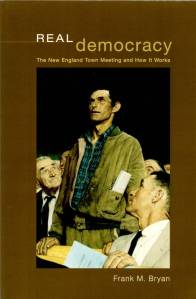
“Town meeting” is direct democracy by citizens. It is a New England tradition dating back to Colonial times. (Just like switchel!) This post is about town meeting as practiced in Vermont and especially in Cambridge.

Town meeting is a meeting of the town’s registered voters. Every town in Vermont has an annual town meeting in March. Towns may also hold special town meetings at other times. The first Tuesday in March is Town Meeting Day, a state holiday. See 1 V.S.A. § 371.

Town Meeting Day is such a big deal in Vermont that in 2007 the legislature added the right of employees to (generally) take unpaid leave to attend their annual town meeting. There are some qualifications, and there is a notice requirement. See 21 V.S.A. § 472b.

At the annual town meeting, voters:

  • Elect town officers
  • Approve the annual town budget
  • Consider public questions

Officers: Typical elected officials in Vermont towns include selectboard members, town clerk, town treasurer, delinquent tax collector, listers, auditors, constable, library trustees, cemetery commissioners, etc. Also elected is a town moderator who is the official in charge of running floor votes at town meeting. The town clerk is the official in charge of running Australian ballot votes at town meeting. (See below for discussion of the difference between floor votes and Australian ballot votes.)

Budgets: The selectboard proposes an annual town budget, and the citizens vote on it.

Public questions: This is everything else. A “public question” may range from the purchase of land for town purposes to a statement about national or world affairs.

The agenda for a town meeting is called a “warning.” Each item in the warning is called an “article.” Substantive issues cannot be considered at town meeting unless they are in the warning. The selectboard drafts the warning. Citizens may petition the selectboard to include an article in the warning by submitting an appropriate request signed by at least 5% of the registered voters in the town.

A key thing to understand about town meeting is how articles are decided. They are decided by one of two possible methods:

  • Floor vote
  • Australian ballot

Floor vote: A floor vote may be decided by a voice vote, division of the house (standing vote or show of hands), or paper ballot. The moderator will know the rules for which method must or may be used in various circumstances. If decided by paper ballot, voters write down how they are voting on blank paper ballots. The ballots will be collected and counted, and the results announced, before the meeting continues. Regardless of the method, a citizen must be present at town meeting to participate and have their vote counted.

Australian ballot: The Australian ballot method uses pre-printed ballots. Voters mark their ballots and place them in the ballot box. Voting takes only a few minutes and can be done throughout the day. Citizens need not be present at town meeting to cast their ballots. Ballots are counted at the end of the day.

The Australian ballot method is convenient. Voters can stop by at any time the polls are open (7 a.m. to 7 p.m. in Cambridge), cast their ballot, and be on their way. They can even vote by absentee ballot before Town Meeting Day.

But articles decided by Australian ballot are fixed in stone. They can only be voted up or down. They cannot be amended. Articles decided by floor vote can be amended during the floor discussion, which provides for considerable flexibility. Furthermore, the floor discussions are often interesting and illuminating.

The default voting method in Vermont town meetings is to decide articles by floor vote. This makes sense because in town meeting the voters are the legislative branch of government. A legislature is a “deliberative assembly” (Wikipedia). That means there must be an assembly (i.e., a meeting) and an opportunity for discussion and amendments. A member of the legislature in Montpelier must be physically present to vote and be counted on matters before the legislature. That’s how legislatures work. It is the same for citizens in Vermont town meetings for issues that are decided by floor vote.

Nevertheless, Vermont allows its towns to change to the Australian ballot method, if they wish, for some or all of the issues that are decided in town meeting in any or all of the three categories listed above: officers, budgets, and public questions. In Cambridge town meeting, all issues are decided by floor vote. (In Cambridge town school district meeting, officers and public questions are decided by floor vote, while budgets are decided by Australian ballot; but this series of posts is not about school districts.)

Vermont law requires that some issues be decided by Australian ballot, such as a vote to borrow money for a period of more than five years.

The more a town uses the Australian ballot method, the less vibrant is town meeting. When articles are decided by floor vote, it is not unusual for voters to change their mind as a result of comments made by their neighbors during floor discussions. This is a powerful form of community and local democracy that one does not get at the ballot box.

The Vermont Secretary of State publishes more information about town meetings here, including a Citizen’s Guide to Town Meeting. There is also information at that link about the various voting methods used by Vermont towns. Different towns use different methods for voting on the various issues that come before town meeting. Every possible combination of voting methods in used somewhere in Vermont.

For a good discussion of why Vermont uses the phrase “Australian ballot” see this 2014 article in the Burlington Free Press: In Vermont, ballots are Australian.

Earlier posts on this blog discuss Cambridge town meetings in 2017 and 2018. The next annual town meeting in Cambridge will begin at 9:00 a.m. on Tuesday, March 5, 2019 at the gymnasium at the Cambridge Elementary School in Jeffersonville (a village within the town of Cambridge).

Click here to go to the initial post in this series: “Learning about town government.”

Posted in General | Tagged , , | 2 Comments