Local Governance in the News

The Community Engagement Team (CET) in my town of Cambridge was featured on the front page of the local newspaper the News & Citizen on 9/28/17:

Cambridge looks to boost turnout for town meeting

CET Chair Tyler Machia was quoted extensively. More information about the CET, including links to agendas, minutes, etc., can be found in my previous blog post here.

The CET is doing good work. The members of this committee (I am one) are working on several improvements for town meeting in March 2018, including childcare, the number and placement of microphones, and information for citizens, among other things.

Another aspect of the CET’s work is improving how to present and vote on issues (“articles”) at town meeting. We have consulted several sources for advice in this regard, including the Vermont League of Cities and Towns and an attorney with experience in this area, James Barlow.

Coincidentally, Attorney James Barlow was mentioned in an article in VT Digger on 9/29/17 about governance changes being considered in the town of Bennington:

Bennington considers local tax and government restructure

Bennington hired Mr. Barlow as a consultant to help them evaluate options for changing their local governance. There is a photo of Mr. Barlow at the link. The article includes discussion of the various ways that towns handle local governance: select board, town administrator, town manager, and – for larger towns and cities – mayors of various types. Bennington is larger than Cambridge,* and local governance there will therefore look different. But it is interesting to know the full landscape of local governance options that are used by municipalities in Vermont.

*In the 2010 Census, the population of Cambridge was 3,659 while Bennington’s population was 15,764 – nearly the size of the cities of Rutland (16,495) and South Burlington (17,904).

Posted in General | Tagged , , | Leave a comment

Thoughts about the Farm Credit System

One of the themes of this blog is that I sometimes think about public life in terms of three sectors:

  • Government
  • For-profit
  • Not-for-profit

I worked for the Farm Credit System for 32 years, retiring at the end of 2016. How does the Farm Credit System fit into my classification scheme? That is an interesting question, which I consider in this post. My story involves all three sectors. After considering that question, I discuss things I learned from my career in the Farm Credit System, as related to themes of this blog.

Continue reading

Posted in General | Tagged | 1 Comment

Questions about domain names

In my earlier post titled Town website addresses, I wrote about three top-level Internet domains: .com, .org, and .gov. That corresponds to the three sectors of public life that I think about: for-profit, not-for-profit, and government.

There is another paradigm that one can use to classify the world, including website addresses: by geography instead of by sector. There is an Internet top-level domain scheme that corresponds to countries instead of sectors. Websites in the United States can use a .us top-level domain. Canada is .ca and Mexico is .mx.

Government entities in the United States sometimes use .us website addresses. Over on my other blog, I recently put up a blog post about a hike that Mrs. TSP and I did that went through parts of the Green Mountain National Forest, and I included a link to the United States Forest Service. Their website is http://www.fs.fed.us.

Some towns in Vermont use .us as the top-level domain for their municipal website. My earlier blog post on town website addresses noted that Westford was one such town. Their website is http://westfordvt.us. About 20 towns or villages in  Vermont use a .us top-level domain for their municipal website.

The Wikipedia article on .us provides helpful information. It says that the .us top-level domain “has primarily been used by state and local governments.” But it also says that the popularity of the .us domain has been decreasing. In one place it says “many local governments have transitioned to .org and other TLDs” (TLD = top-level domain). In another place it says “Use: U.S. state and local governments (declining in favor of .gov).”

How do .us top-level domains work? How does one get started with that style of website address? I know that to register a .com or .org website address, one typically uses a commercial service such as GoDaddy or Tucows (their retail arm is Hover) or WordPress, and that to register a .gov top-level domain in the United States one must use the DotGov service run by the General Services Administration. What are best practices for using a .us top-level domain? Especially for a municipal website like, say, a future version of the website for the town of Cambridge, Vermont?

Someone somewhere must have written a blog post, a white paper, a standard or, heaven forbid, a government regulation that deals with these questions. If you have any information beyond what is in the Wikipedia article referenced above, please share in the comments or contact me directly.

Which top-level domain do you think the Cambridge municipal website should use? If you have an opinion, please feel free to share in the comments or contact me directly.

UPDATE 9/03/17: See the third and fourth comments under my earlier post Town website addresses for yet another option for a future version of the municipal website for the town of Cambridge, Vermont: cambridge.vt.gov.

Posted in General | Tagged , | Leave a comment

Democracy in America

I recently purchased, and am reading, the book Democracy in America by Alexis de Tocqueville.

I will refer to this book from time to time on the blog. In this post, I discuss some background about the book.

Alexis de Tocqueville was a Frenchman who, as a young man, toured the United States, as a young country. He had studied history and law. He wanted to learn how democracy worked in America, so that he could take lessons back to France.

Tocqueville spent nine months touring the United States in 1831-1832. He visited 17 of the then 24 states. He visited with many people, both famous and not, including President Andrew Jackson, his predecessor John Quincy Adams, the last surviving signer of the Declaration of Independence—Charles Carroll of Maryland, and Sam Houston of Texas (not yet a state). Tocqueville was 25 years old when he left for America. He traveled with a friend, Gustave de Beaumont, who was 29.

You can learn more about the tour that Tocqueville and Beaumont took in the United States from the Alexis de Tocqueville Tour, a series of programs produced by C-SPAN in 1997-1998 that followed the path they took. Links: Wikipedia, C-SPAN.

After returning to France in 1832, Tocqueville wrote Democracy in America, published in French in two volumes—one in 1835 and one 1840. English translations were published at the same time. Today the two volumes are usually published as one book. I purchased the translation by the husband and wife team of Harvey Mansfield and Delba Winthrop of Harvard University, first published in 2000. I have the paperback edition published in 2002. The first sentence in the Editors’ Introduction is:

Democracy in America is at once the best book ever written on democracy and the best book ever written on America.

Clearly there is continuing interest in what Tocqueville had to say, as evidenced by the 1997-1998 C-SPAN series, the 2000 translation by Mansfield and Winthrop, and three other new translations since then per Wikipedia. Democracy in America is often quoted even today by people from across the political spectrum.

I won’t pretend that I am reading the book straight through. It is massive at about 800 pages, which includes both original volumes plus 75 pages or so of introduction and notes by Mansfield and Winthrop. But the book is well organized, and I am guided in my study by a set of lectures from The Great Courses Company: Tocqueville and the American Experiment, which I have listened to several times since purchasing it in 2006.

The course guide for Tocqueville and the American Experiment lists the following major themes in the book:

Democracy is the way of the future.

Because of changes taking place in the world, there is a need for a new political science. Democracy in America is meant to be a part of this new political science. America has a unique history and geography, and its form and practice of democracy cannot be imitated.

The essence of democracy is equality.*

Democracy depends on broad participation of citizens in public life at the local level. [This resonates with me now that I am on the town selectboard!]

Equality* leads people to withdraw into themselves.

The success of democracy hinges on vibrant local political and social institutions that will limit the centralization of administrative power and encourage people to be active in politics.

*By “equality,” Tocqueville does not mean equality of outcomes. He means something closer to equality of opportunity, but it is not exactly that, either. He certainly means to include equality before the law, but it is more than that. Included in his meaning is a lack of aristocracy (he was himself a French aristocrat). He also had many negative things to say about slavery. Tocqueville calls what he means “equality of conditions.”

Posted in General | Leave a comment

Town website addresses

As discussed here and here, I sometimes think about public life in terms of three sectors:

  • Government
  • For-profit
  • Not-for-profit

These three sectors align nicely with Internet top-level domains:

  • Government = .gov
  • For-profit = .com
  • Not-for-profit = .org

I live in the town of Cambridge, Vermont. The websites for my town and the eight surrounding towns are:

That is quite a variety of website address formats!

Municipalities are part of government, and I believe they should use the .gov domain. It is misleading for a governmental entity to use a .com or .org domain. I hope that my town can change to the .gov domain in the future.

I think it is nice when the website address includes the state (“vt”), since there are many municipalities of the same name in multiple states. For example, one should not confuse my town of Cambridge, Vermont, population 3,659 in the 2010 census, with the city of Cambridge, Massachusetts, population 105,162 in the 2010 census (website www.cambridgema.gov), and the home of Harvard University and the Massachusetts Institute of Technology.

I also think it is nice when the website address indicates what kind of municipality it is, such as “townof”, “villageof”, “cityof” or “countyof”. In the case of my town, that leaves room for “villageofcambridgevt.gov” should the village of Cambridge (which is distinct from the town of Cambridge) decide to create its own website in the future. In Vermont, there are many instances of a town and a village, or a town and a city, or a town and a county, with the same name. This convention would reduce confusion.

The conventions in the preceding paragraphs are consistent with guidance in federal regulations at 41 CFR § 102–173.55 “What is the naming convention for Cities and Townships?” (CFR = Code of Federal Regulations) issued in March 2003 and further clarified in this news release issued in September 2003 by the General Services Administration, part of the executive branch of the federal government. Quotes from the news release:

In order for Gov domains and URLs to be of value to citizens dealing with the various units of Government, we would like to evolve to predictable URLs that conform to the regulations…

In some cases, the non-conforming names may create confusion or wasted browsing for citizens seeking information.

The .gov domain only applies in the United States. Internet addresses in this domain are governed by www.dotgov.gov, a service operated by the General Services Administration. This link lets you test if a domain name is available.

The Internet address townofcambridgevt.gov is available.

Posted in General | Tagged , | 5 Comments

Cloverdale Presentation

Cloverdale was a distinct, close-knit community mostly in Westford, Vermont, but also including the Putnam Farm in the adjacent town of Cambridge. It lasted for more than 150 years, from 1804 until the 1950s and 1960s when my siblings and I were growing up on the Putnam Farm.

My sister Beth Putnam Cole and I recently gave presentations about the history of Cloverdale to the Cambridge Historical Society and the Westford Historical Society.

Click here for our presentation (5 MB PDF, 60 pages, lots of photos)

Click here for our notes for the presentation (65 KB PDF, 19 pages)

Many thanks to the enthusiastic audiences at both presentations! Both audiences included residents of Cloverdale who added to and corrected some of our comments. Audience input is included in the notes at the preceding link.

Our presentation was based on a book about Cloverdale written in 2001 by our father Harold Putnam and a cousin Jane Clark Brown – Cloverdale: An Anecdotal History of A Rural Neighborhood. Click here for a link to that book.

Thanks to Peter Opstrup of the Cambridge Historical Society for prompting this adventure, and to Caroline Brown of the Westford Historical Society for welcoming our presentation there as well.

Posted in General | Tagged | 4 Comments

Cloverdale Book

Cloverdale was a distinct, close-knit community mostly in Westford, Vermont, but also including the Putnam Farm in the adjacent town of Cambridge. It lasted for more than 150 years, from 1804 until the 1950s and 1960s when my siblings and I were growing up on the Putnam Farm.

My father Harold Putnam and a cousin Jane Clark Brown wrote a history of Cloverdale in 2001 – Cloverdale: An Anecdotal History of A Rural Neighborhood.

The original document was an 11″x11″ color scrapbook. A smaller book, roughly 5″x7″, containing the same material, was printed in 2002 by Eagle’s Loft Design of Eden, Vermont. That book was in black and white. Several dozen copies of that book were printed and distributed locally.

The cover of the 11″x11″ scrapbook is shown above. Click here to read it in full (4 MB PDF, 33 pages). Thanks to Peter Opstrup of the Cambridge Historical Society for scanning a copy of the original scrapbook.

Posted in General | Tagged | 1 Comment

Mansplaining

Recently I was in the awkward position of explaining to a woman the concept of mansplaining.

What is mansplaining? This clip from the television series Silicon Valley explains:

Ouch.

What can we men do to improve our communication skills?

This short article contains good advice. Please follow the link. It won’t take you long to read, and there are five excellent tips in that column that everyone can use to improve the art of conversation.

Many thanks to a family member and a friend, neither of my generation, for the links.

I maintain that my awkward situation in the first sentence was not an instance of mansplaining because she didn’t already know (see the last line in the video) and she asked for an explanation (see tip #3 in the article). That’s my story and I’m sticking to it.

Update 7/03/17: This post was rewritten to improve clarity.

Posted in General | Leave a comment

Quantum Birthday Thought

The image to the left is a birthday card. Inside the card it says:
Don’t worry… It will make more sense after you start drinking.

I am reminded of something Richard Feynman said. Richard Feynman (1918-1988) won a Nobel prize in physics in 1965 for work in quantum electrodynamics.

In 1961-63 Feynman created and taught a completely revamped two-year introductory physics course at Caltech, known as The Feynman Lectures on Physics. These famous lectures were published and are now available online for free at the link in the preceding sentence.

The third lecture was titled “The Relation of Physics to Other Sciences” and Feynman ended the lecture as follows:

A poet once said, “The whole universe is in a glass of wine.” We will probably never know in what sense he meant that, for poets do not write to be understood. But it is true that if we look at a glass of wine closely enough we see the entire universe. There are the things of physics: the twisting liquid which evaporates depending on the wind and weather, the reflections in the glass, and our imagination adds the atoms. The glass is a distillation of the earth’s rocks, and in its composition we see the secrets of the universe’s age, and the evolution of stars. What strange array of chemicals are in the wine? How did they come to be? There are the ferments, the enzymes, the substrates, and the products. There in wine is found the great generalization: all life is fermentation. Nobody can discover the chemistry of wine without discovering, as did Louis Pasteur, the cause of much disease. How vivid is the claret, pressing its existence into the consciousness that watches it! If our small minds, for some convenience, divide this glass of wine, this universe, into parts—physics, biology, geology, astronomy, psychology, and so on—remember that nature does not know it! So let us put it all back together, not forgetting ultimately what it is for. Let it give us one more final pleasure: drink it and forget it all!

Quantum physics is strange. Feynman once said: “I think I can safely say that nobody understands quantum mechanics.” (source – the quote comes from lecture #6)

A few years ago I read a fascinating book titled Quantum Reality. Click here for an overview of the ideas in the book. Interesting stuff.

Posted in General | Leave a comment

Quilt square by Anne Standish

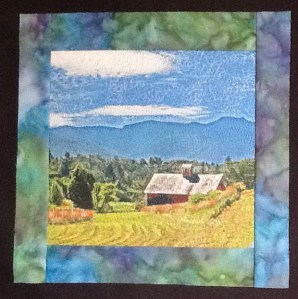
Anne Standish of Cambridge has contributed a beautiful quilt square on behalf of the town to the Vermont League of Cities and Towns for their Local Government Quilt Project:

VLCT launched its Local Government Quilt Project in 2005 to celebrate the Town Fair 2005 theme of “Cities and Towns – Working Together, Making a Difference.” … To date, seventy-five Vermont municipalities have submitted handcrafted squares… The first 47 squares plus a VLCT square were bound into the first quilt, which former Governor Douglas unveiled at Town Fair 2005. A second quilt, introduced at Town Fair 2009, consists of another 12 squares; a third quilt is in progress.

As reported this week in the News and Citizen: “Anne…recently retired from a career in health care to focus on her second career as an art quilter.”

Anne’s website notes that “Anne’s inspiration comes from her surroundings – the landscapes she sees every day around her home in Cambridge, Vermont.”

The quilt square of Pleasant Valley and Mount Mansfield pleasingly captures the beauty of our town.

Thank you, Anne!

Posted in General | Tagged | Leave a comment