Classifying Public Life: Discussion and Examples

In the previous post I discussed how I sometimes think about public life in terms of three sectors:

  • Government
  • For-profit
  • Not-for-profit

And sometimes in terms of two sectors:

  • Government
  • Society (= for-profit + not-for-profit)

In this post I further discuss my views on these sectors, with examples.

Consider three examples from recent posts on this blog about Cambridge, and how they fit into my three-way classification scheme:

Whenever we encounter (or create) an organized group or activity, we do well to think about which of the three sectors it falls into, and its relationship to the other two sectors.

My preference is to keep as much of public life as possible out of the government sector, and in the for-profit and not-for-profit sectors.

One reason relates to the question in the header: What is a proper relationship between a free people and their government? Consider my two-way classification of public life between government (which is compulsory) and society (which is voluntary). The more government, the more compulsion; and the less freedom for the people. If taken far enough, there will be no such thing anymore as a free people. Having “a free people” is important to me.

This reason for preferring limited government can be restated in terms of power. We all are wary of too much power in the hands of others. Certainly corporations in the for-profit sector can be powerful. Entities in the not-for-profit sector can also be powerful. But only government has the power to legally take from us by force our property and our liberty. We do well not to give government too much power.

A second reason for preferring limited government is as follows. Many ideas sound good initially, and may even be good at the outset, but as time goes on it becomes clear that they need to end. This is readily accomplished in the for-profit and not-for-profit sectors. In both sectors it is common for entities to cease to exist when they have outlived their usefulness. There is a name for this concept in the for-profit sector: creative destruction. But there is no comparable process in the government sector. Once a government program is created, it is difficult to end it even when doing so would benefit the greater good.

For both of the above reasons, it is wise to be cautious in creating government programs.

My only prior experience serving in government, before being elected to the Cambridge selectboard earlier this year, was when the governor appointed me to the Vermont Agricultural Development Board in 2010. (It became the Vermont Agricultural and Forest Products Development Board in 2012.) I remember once commenting to my fellow board members about “our role in government” and being surprised that some of them were surprised at the thought that they were serving in government. This is one way that government expands – when we aren’t paying attention to its boundaries.

Of course the VAFPDB was in the government sector. Granted, we were only advisory, but our opinions were (hopefully) being considered by people in the legislative and executive branches of government with the power and authority to enact government policies and programs. That was why the board was created. I resigned from the VAFPDB in 2013 in part because I felt that it was being asked to do things that in my view were better left to the for-profit and not-for-profit sectors.

Returning to the Cambridge examples listed above:

The management of cemeteries by cemetery associations falls in the not-for-profit sector. When there is no cemetery association, it falls to government to assume this responsibility and it is appropriate for a cemetery commission to exist as part of government.

The Villages Project is a type of mutual aid society as has existed throughout history and enriched society in countless ways. It is appropriately part of the not-for-profit sector.

The commuter bus is part of government because it is operated by a government entity (Green Mountain Transit) and mostly paid for by government (88%). As noted in the post about the commuter bus, the voters in Cambridge will have an opportunity at town meeting in March 2018 to decide if they want to continue this service.

Posted in General | Tagged , | Leave a comment

Classifying Public Life

Three sectors of public lifeI sometimes think about public life in terms of three sectors:

  • Government
  • For-profit
  • Not-for-profit

Government makes the rules that everyone lives by. The for-profit sector provides most of the goods and services that we use. The not-for-profit sector fills in the gaps, especially when the other two sectors do not provide a complete and satisfying life for everyone.

Any one person may spend their entire life in only one sector, but collectively we need all three sectors. All three sectors are necessary and proper.

No sector is better or worse than the other two. Done well, each of the three sectors is noble. Almost every not-for-profit entity has a noble mission, and most of the people in that sector are altruistic and unselfish – as are most people in the other two sectors. Most people in all three sectors are good people, although there are a few selfish people and bad actors in all three sectors, about equally distributed as far as I can tell.

Some on the right may generally distrust government and believe that government is, at best, a necessary evil. Some on the left may generally distrust the for-profit sector and believe that it is, at best, a necessary evil. I do not hold either view.

We are a better people when living under an appropriate rule of law provided by government, as opposed to being a feral mob as in Lord of the Flies. We need government to provide rules for public interactions and prevent anarchy.

The for-profit sector also makes us a better people. The essence of the for-profit sector is serving others by providing something they want while using resources wisely enough to hopefully make a profit. That in itself is a nobility that is often insufficiently recognized, but there are further reasons to appreciate the for-profit sector. Most innovation occurs in the for-profit sector. And it is the for-profit sector that creates the wealth that supports both government and the not-for-profit sector and provides our high standard of living.

The three sectors must work together, but we do well to keep in mind their differences. I believe that confidence in our public institutions would be stronger if we keep these three sectors in mind, with their respective strengths and weaknesses, and adjust our expectations according.

It is also useful sometimes to think of public life in terms of just two sectors. The for-profit and not-for-profit sectors can be combined into “society.” Government remains as its own sector. The distinguishing factor between these two sectors is that the essence of government is that it is compulsory, while the essence of society is that it is voluntary.

Government and society have a yin and yang relationship with each other. They are complementary opposites. Neither is complete without the other. Together they create community and civilization.

This two-way classification of public life corresponds to the question in the header: What is a proper relationship between a free people (i.e., society) and their government? There is no final, definitive answer to that question, but it is a useful question for framing discussions about government and citizenship.

I will return to these classifications, both three-way and two-way, in future posts. Please feel free to share your thoughts in the comments.

Posted in General | Tagged | Leave a comment

Jeffersonville Commuter Bus

The Jeffersonville Commuter bus will continue to operate through June 30, 2018 without any reduction in service.
Click here for the bus schedule – see Route 36. Green Mountain Transit (GMT) is the regional transit authority that operates the bus.

Previously service was assured through June 30, 2017 but it was uncertain what would happen after that. GMT’s board of directors took action today (May 16, 2017) to assure that the bus will continue to operate through June 30, 2018.

GMT says that annual costs for the bus route are $236,400 and fares cover $27,500 (12%). That leaves $208,900 (88%) to be paid by government. Federal and state grants covered 100% of the costs net of fares through June 30, 2016, but only 80% after that. That left $41,780 for local communities to cover per year. GMT annually requested $14,000 each from the towns of Cambridge, Underhill and Jericho, totaling $42,000. (For readers outside the area, Jeffersonville is a village in the town of Cambridge.)

All three towns paid that amount for the year ending June 30, 2017. Things got complicated for the year ending June 30, 2018. Jericho agreed to pay $14,000. The Underhill Selectboard initially said that Underhill would not pay anything, but a motion was passed from the floor at the Underhill town meeting in March 2017 to pay $5,000. On May 9, 2017 the Underhill Selectboard voted to increase their contribution to $10,000. In Cambridge the issue was discussed but not resolved at town meeting in March 2017. On April 17, 2017 the Cambridge Selectboard voted to pay $14,000 (minutes). Events in Cambridge transpired as recommended in my memo on this issue dated March 24, 2017 (link). That memo includes more detailed information about this issue, including ridership numbers through February 2017.

In summary, after the action of the Underhill Selectboard on May 9th, GMT was only $4,000 short of the amount it requested. GMT’s board of directors voted on May 16th to use $4,000 of its own funds to make up the shortfall.

All three towns will have decisions to make next spring about funding after June 30, 2018. In Cambridge at least, it is currently the intent of the Selectboard that the voters will decide this issue at town meeting in March 2018. By then we will have more information, including the results of a study that GMT is conducting, with the help of an outside consultant, of all their routes.

Look for an update in the 2017 Cambridge annual report when it comes out next winter.

Posted in General | Tagged , , | Leave a comment

The Villages Project

The Villages Project is an initiative to provide services to the elderly in their homes in order to allow them to age in place, without moving to an elder care facility. The concept originated with a group of citizens in the Beacon Hill neighborhood of Boston in 2001. See Beacon Hill Village.

That initiative has inspired the formation of more than 200 Villages in the United States and other countries. The Village to Village Network was formed in 2010 to provide guidance, resources and support to help communities establish and maintain their Villages.

The Wikipedia article on “Elder village” is a useful primer on this topic. Note that “Village” in this context is a virtual village, really a nonprofit organization, not a municipal entity.

This concept is currently being explored by a group of interested citizens in Cambridge. The Cambridge Selectboard heard a presentation at its meeting on February 27, 2017 (minutes, see page 2) and will hear an additional presentation at its next meeting on May 15, 2017 (agenda).

UPDATE: Related – a New York Times article dated 5/19/17 about the architectural challenges of aging in place: Planning to Age in Place? Find a Contractor Now.

Posted in General | Tagged , | 1 Comment

Cemetery Commission

The Town of Cambridge has several boards, committees and commissions, both elected and appointed. As I learn the job of the selectboard, I am also learning what these other groups do. This post is about the cemetery commission.
Cemeteries are the subject of Vermont Statutes Title 18 Chapter 121 (§§ 5300-5579). Cemeteries that are not operated by an independent cemetery association or a church are the responsibility of the town. The selectboard is responsible for such town cemeteries unless the town has voted to establish a board of three or five cemetery commissioners (18 V.S.A. § 5373 and § 5374). The Town of Cambridge voted to establish a board of three cemetery commissioners at its annual town meeting on March 6, 1979. Click here for the warning and minutes pertaining to that action.

The 2016 Town of Cambridge annual report (here) lists “Cemetery Commission” under both elected town officers and appointed town officers, but no names are listed. I believe the intent was that there be one elected commissioner and two appointed commissioners, but all positions were unfilled at the time.

At town meeting on March 7, 2017, Sandra (Sandy) Albright was elected cemetery commissioner (minutes here). At the first selectboard meeting following town meeting, on March 20, 2017, the selectboard appointed Jennifer Bartlau and Kate McCuin Clark as additional cemetery commissioners (minutes here).

A reading of the statutes mentioned above indicates that all three cemetery commissioners should be elected, with rolling three year terms. At the next town meeting in March 2018, we should make this so.

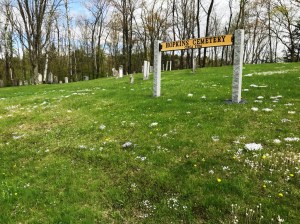
The cemetery commission is responsible for the care and management of the town’s cemeteries, with specific responsibilities in the statutes listed above. The selectboard has no role. Sandy Albright has identified the following cemeteries in Cambridge that the cemetery commission is responsible for: East Cambridge, South Cambridge, North Cambridge, Gates, Giddings, Hopkins, and Smilie. The photo above is the Hopkins Cemetery on Bryce Road. The sign says: “Hopkins Cemetery circa 1794.”

Also within the town are two cemeteries overseen by independent cemetery associations: Jeffersonville Cemetery in Jeffersonville Village and Mountain View Cemetery on Bartlett Hill Road.

Posted in General | Tagged , | Leave a comment

Job of Selectboard Member

The Vermont Secretary of State’s website has concise descriptions of various local government offices: Local Office Descriptions.

I found this one amusing:

Selectboard Members (elected). General supervision and control over town; enacts ordinances, regulations, and policies for town; oversees town property and personnel; prepares, presents and manages budget; and oversees roads, including laying out, discontinuing, and reclassifying roads. Sits as local board of health, liquor control commission, and sewer commission. Should know the town well, be able to understand all sides of complex issues, and have very thick skin.

Posted in General | Tagged | 2 Comments

Acadia vs. Arcadia

Et in Arcadia ego

Over on my other blog, I recently wrote about a trip to Schoodic Peninsula on the coast of Maine, part of Acadia National Park. This leads to a question: what is the difference between “Acadia” and “Arcadia”?

The short answer is that the original word was Arcadia, in reference to ancient Greece, but the ‘r’ got dropped at a point in history.

From the Wikipedia entry for Arcadia:

Arcadia is one of the regional units of Greece. It is part of the administrative region of Peloponnese. It is situated in the central and eastern part of the Peloponnese peninsula. It takes its name from the mythological figure Arcas. In Greek mythology, it was the home of the god Pan. In European Renaissance arts, Arcadia was celebrated as an unspoiled, harmonious wilderness.

There is much more at the link, including a map of Arcadia in Greece.

In the early 1500s the Florentine explorer Giovanni da Verrazzano, sailing on behalf of France in voyages of exploration to the New World, used the name “Arcadia” – with the ‘r’ as in the Greek name – for all of the North American coast north of Virginia because of the “unspoiled, harmonious wilderness.”

In the early 1600s Samuel de Champlain dropped the ‘r’ for unknown reasons and assigned the name “Acadia” (Acadie in French) to one of the five colonies in New France.

From the Wikipedia entry for Acadia:

Acadia was a colony of New France in northeastern North America that included parts of eastern Quebec, the Maritime provinces, and modern-day Maine to the Kennebec River…Today, the term Acadia is used to refer to regions of North America that are historically associated with the lands, descendants, and/or culture of the former French region. It particularly refers to regions of the Maritimes with French roots, language, and culture, primarily in New Brunswick, Nova Scotia, the Magdalen Islands and Prince Edward Island, as well as in Maine. It can also be used to refer to the Acadian diaspora in southern Louisiana, a region also referred to as Acadiana. In the abstract, Acadia refers to the existence of a French culture in any of these regions.

There is much more at the link, including a map of Acadia in New France.

Henry Wadsworth Longfellow wrote about the expulsion of the Acadians from the Maritime Provinces during the French and Indian War in his memorable 1847 epic poem Evangeline, A Tale of Acadie. England defeated France in the French and Indian War of 1754-63 (known as the Seven Years’ War in the rest of the world) and in the New World, New England survived while New France did not. But the word “Acadia” lived on.

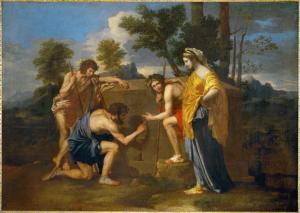
Tom Stoppard used the older word – with the ‘r’ – as the title of his fascinating 1993 play: Arcadia. He considered naming the play “Et in Arcadia ego” after the famous painting by Nicolas Poussin in the Louvre in Paris, pictured above. The Latin phrase is commonly translated as “even in Arcadia, there am I [Death].” The painting shows shepherds around a tomb; it is a reminder of our mortality, even in what seems to be an earthly paradise.

The first Wikipedia quote above says: “In European Renaissance arts, Arcadia was celebrated as an unspoiled, harmonious wilderness.” That doesn’t quite capture the original meaning of “Arcadia.” The following quote, from the Wikipedia entry for the painting “Et in Arcadia ego,” gives a better sense of the word:

During Antiquity, many Greeks lived in cities close to the sea, and led an urban life. Only Arcadians, in the middle of the Peloponnese, lacked cities, were far from the sea, and led a shepherd life. Thus for urban Greeks, especially during the Hellenistic era, Arcadia symbolized pure, rural, idyllic life, far from the city.

As an aside, I have been writing in other blog posts here about the parallels between ancient Greece and modern New England, especially Vermont, in terms of democracy. Perhaps Vermont, the most rural state and the only New England state that does not touch the sea, is the true Arcadia in the New World.

If you ever have a chance to see a production of Tom Stoppard’s play Arcadia, I highly recommend it. It is one of the wittiest, deepest, and most thought-provoking plays I have ever seen. Following is a small example of its wit, which can be appreciated once one knows about the painting discussed above. Thomasina is a precocious 13-year old. Lady Croom is her mother, and she does not like being corrected.

LADY CROOM: (speaking of the grounds and gardens of her estate) …in short, it is nature as God intended, and I can say with the painter, “Et in Arcadia ego!” “Here I am in Arcadia,” Thomasina.

THOMASINA: Yes, Mama, if you would have it so.

LADY CROOM: Is she correcting my taste or my translation?

THOMASINA: Neither are beyond correction, Mama, but it was your geography caused the doubt.

[The play is set in England, not Greece.]

Posted in General | 6 Comments

Learning About Government

One of my stated goals in retirement, after a career in business, was to learn about government. So, four months into retirement, what am I learning?
When I wrote (in December and February) that I wanted to learn about government, I had in mind state government. And my plan was to be a casual observer, not a participant. Well, that plan didn’t last long! I am now immersed in town government instead of state government. And as a member of the town selectboard, I am a participant not an observer.

What does a town selectboard do? The Vermont Legislature says that the selectboard is responsible for the “the general supervision of the affairs of the town … not committed by law to the care of any particular officer.” That’s reasonably vague. Selectboards are responsible for local roads and animal control, for example, among other things. I am learning that there is a lot going on in town that I didn’t know about before – not just on the selectboard but also in a host of other local boards, commissions and committees. One of my first activities was to delve into the local commuter bus, which was the subject of a confused discussion at town meeting last month. This was something I knew little about, and it involved coordination with the town conservation commission. There is a lot to learn.

Fortunately there are resources to help local officials learn and perform their jobs. The Vermont League of Cities and Towns provides numerous handbooks and workshops for local officials. I attended their Spring Selectboards Institute last month. The University of Vermont Extension Service puts on an annual Town Officers’ Education Conference which I attended earlier this month. Town Clerk/Treasurer Mark Schilling attended both events with me.

At those conferences I learned about “Dillon’s Rule” vs. home rule. Vermont is a Dillon’s Rule state – municipalities have only those authorities granted by the Legislature. I also learned about Vermont’s Open Meeting Law. Both topics are new for me, but not completely unexpected.

There is one topic I’m learning about that was completely unexpected. When I decided to run for local office, I did not anticipate being involved in discussions about the theory and practice of democracy itself.

As a result of lively discussions at town meeting last month, the selectboard created a Community Engagement Team to explore issues of citizen involvement in local government. I am on this committee representing the selectboard. More information is on the town’s website here (committee meeting agendas and minutes) and here (other committee documents).

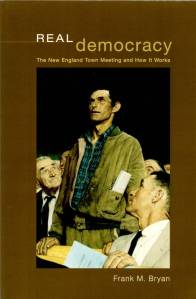
This is an interesting topic! I had previously read All Those In Favor: Rediscovering the Secrets of Town Meeting and Community by Susan Clark and Frank Bryan, mentioned in my earlier blog post Town Meeting Thoughts. I am now reading Real Democracy: The New England Town Meeting and How It Works by Frank Bryan, pictured above. This is a great book for learning about democracy as practiced in both Athens, Greece, two thousand five hundred years ago, and in Athens, Vermont, today.

The image on the cover of Real Democracy is Norman Rockwell’s famous Freedom of Speech painting, inspired by an actual event that he witnessed at a Vermont town meeting. The citizens of Arlington, Vermont, held a special town meeting in the winter of 1941 to discuss construction of a new school to replace the one that had burned. Jim Edgerton was the only person in town opposed to the new school, yet all listened respectfully to him. Click here for the story of Norman Rockwell’s memorable Four Freedoms paintings which illustrated the themes in President Franklin Roosevelt’s famous Four Freedoms speech.

UPDATE 3/08/18: The New York Times has an article today about an upcoming exhibition of the Four Freedoms paintings: “Norman Rockwell’s Vision of F.D.R.’s Four Freedoms.” (Subscription probably required, sorry.) The exhibition will be titled “Enduring Ideals: Rockwell, Roosevelt & the Four Freedoms.” It will initially be at the New-York Historical Society May 25 to Sept. 2, and then it will travel. Details in the article.

Posted in General | Tagged , , , | Leave a comment

Leadership Lamoille

Leadership Lamoille is a leadership program of the Lamoille Region Chamber of Commerce for “today’s managers to become tomorrow’s leaders.” The current class consists of eight participants working in healthcare, education, banking, hospitality and energy fields. There are nine day-long classes in this year’s program, one per month, from September 2016 through June 2017.

Last month I participated in the class on “Community Leadership.” I was impressed with the quality of both the program and the students.

I participated in a panel discussion about the responsibilities of the board of directors for both for-profit and not-for-profit organizations, and the relationship between the board of directors and the chief executive officer or executive director.

I also gave a presentation about financial statements of not-for-profit organizations from the point of view of the board of directors:

Financial Statements and the Board of Directors (pptx)

Financial Statements and the Board of Directors (pdf)

Graduation is June 14. Good luck to the class of 2016-17!

Posted in General | Leave a comment

Town Meeting Thoughts

Town meetings in small towns in New England are unique. Voters come together in person at least annually to decide local issues. This is direct democracy as it was once practiced in ancient Athens. Today no other places in the world, except perhaps the cantons of Switzerland, practice direct democracy like this.

Not everyone is satisfied with town meetings. In my town of Cambridge, Vermont, there was discussion at town meeting this year about how to involve more people, especially young people. Others are also having discussions about town meeting. This blog post contains links to discussions that I know about.

The following article appeared in Seven Days on March 8, 2017, the day after town meetings in Vermont:

Diminishing Democracy? At Kirby Town Meeting, the 18 Percent Rule

This article questions the durability of town meetings.

In 2016 the town of Stowe (just south of Cambridge) created a Town Meeting Task Force “to study the reasons for the decline in voter participation at the annual Town Meeting and to make recommendations on ways to increase participation.” Their report dated November 7, 2016 is at the link in the preceding sentence. Click here for an article in the Stowe Reporter about the 2017 Stowe town meeting, including action on one of the recommendations in the Town Meeting Task Force report.

(It is interesting to note that even though Stowe made no changes between their 2016 and 2017 town meetings, attendance was up from 150 to 250. And the Seven Days article noted that attendance at Kirby was up from roughly 40 to 80. Perhaps town meeting isn’t dead yet. Attendance at Cambridge town meeting this year was 277, not bad considering that Cambridge has about 85% the population of Stowe.)

U.S. News & World Report had an article about town meetings on March 13, 2017:

“Human-Scale Democracy” Credited for Vermont’s Culture

This article credits the culture fostered by town meeting as a key reason for making Vermont a desirable place to live. (Perhaps the same can be said of Switzerland?)

The New England public radio program “Next” had a segment about town meetings on March 16, 2017 (Episode 33):

Firetrucks, Chickens and Democracy at New England Town Meeting

This 18 minute radio program discussed town meetings in several towns in New Hampshire and Vermont. The issues discussed in Wilmington, Vermont were the same as the issues raised in Cambridge: How to involve more young people? Should town meeting be held at a different time of day or on a different day of the week? Should voting for town officers and the town budget be by Australian ballot instead of during the meeting?

All of the above items have something in common – they all mention this book:

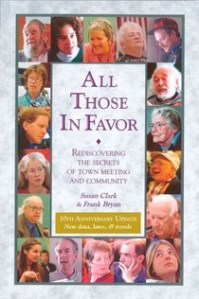
All Those In Favor: Rediscovering the Secrets of Town Meeting and Community

or its authors Susan Clark and Frank Bryan. The image above is the book cover. Susan Clark is an author and educator, and the town moderator in Middlesex, Vermont. Frank Bryan is a professor emeritus of political science at the University of Vermont who has studied town meetings for more than 30 years. The book was published in 2005 and republished with an update in 2015.

The book All Those In Favor makes the case that, done right, there is no better form of local government for small towns than town meeting. The book includes a thorough discussion of the implications of Australian balloting i.e., voting via preprinted ballot as opposed to voting during the meeting following discussion.

Anyone interested in studying town meetings will find useful information in all of the above links, and especially in the book All Those In Favor.

Full disclosure: While I do not know Professor Bryan, I know Susan Clark. She wrote another book on a similar theme – Slow Democracy: Rediscovering Community, Bringing Decision Making Back Home – with coauthor Woden Teachout (Frank Bryan wrote the Foreward). I met Susan in 2013 as a result of this book, and we did a joint presentation together.

Posted in General | Tagged , | 1 Comment