Poems for the silo murals

Cover of Cambridge Annual Report 2016

Cover of Cambridge Annual Report 2016

Two concrete silos stand in the village of Jeffersonville (town of Cambridge) where the Bell-Gates Lumber Corporation once had a sawmill. In 2016 large murals were painted on the silos. The silo murals were featured on the cover of the 2016 annual report for Cambridge (cover at left, full report online here).

The inside of the annual report includes an explanation of the silo murals. The aging farmer on one silo represents the past. The youth on the other silo represents the present and future. Various images on both silos depict human culture and the natural environment in the area. More information is in this article in Seven Days:

New Silo Murals Link Jeffersonville’s Past and Future

The Cambridge Annual Report also includes a beautiful poem which mentions the silo murals among other positive developments in town in 2016:

Bringing Old Things Back to Life in Support of Community

The silo murals remind me of another poem, a famous poem about growing up from a child to an adult. The youth on the south silo is full of potential but is not yet an adult. Perhaps the aging farmer is sharing these thoughts with the youth:

Continue reading

Posted in General | Tagged | 2 Comments

Select Board Member

The town of Cambridge elected me to its Select Board at Town Meeting on March 7, 2017. (See Candidate for Select Board.) I am honored and humbled. Thank you to the voters in Cambridge. I will do my best to serve you.

Yesterday I drove to Montpelier and purchased the Handbook for Vermont Selectboards: A Comprehensive Guide for Vermont Selectboard Members. This handbook is published by the Vermont League of Cities and Towns. I have my homework cut out for me! It’s 240 pages. I also have the free PDF version. I like both versions; the electronic version is handy for searching, while the hardcopy version is easier to read and flip back and forth between sections.

Today I registered for an upcoming workshop put on the Vermont League of Cities and Towns: the Spring Selectboards Institute on March 18.

I am looking forward to learning about and being involved with local government!

Posted in General | Tagged , | 1 Comment

Orange-1 recount: Lessons learned?

The Orange-1 recount matter is now concluded. What lessons can be learned? I wish to highlight two lessons that I hope were learned.

First, I hope that representatives learned that representatives should NEVER count ballots in the election of peers. The Vermont Constitution says that the House of Representatives “shall have power to … judge of the elections and qualifications of their own members …” It seems too much of a stretch to say that this language implies that representatives should be counting ballots. Yes, it has been done before. That doesn’t mean it’s a good thing.

Representatives, regardless of party, have an unavoidable conflict of interest when it comes to counting ballots in the election of peers. No one is going to trust a ballot counting process run by representatives more than they trust a process run by trained town clerks and boards of civil authority who do not have that conflict of interest.

It is the job of representatives to create and oversee election machinery that is independent of themselves. If that machinery needs to be tweaked for future elections, presumably the House Committee on Government Operations will hold hearings and make recommendations.

The second lesson that I hope is learned can be drawn from the comments of Representative Chesnut-Tangerman of Middletown Springs on February 22 (House Journal p. 309):

Having already extended congratulations of Rep. Frenier, I do not challenge the outcome of this process, though I must note the irony that an investigation of possible procedural errors was derailed by a procedural error.

Writing policies and procedures is hard. It is difficult to anticipate every situation and consequence. There are often unintended consequences. I know this from years of writing policies and procedures in my business career. In the Orange-1 recount matter, the unintended consequence affected only representatives, and many would say it did no harm. (I say it did good, since it kept representatives from counting ballots.)

Likewise, writing laws and regulations is hard. Even with good intentions, there are often unintended consequences that affect many more people than just representatives, and they are almost never to the good. I hope that our public officials keep that in mind when writing laws and regulations. I hope that they write laws and regulations with humility.

Posted in General | Tagged | Leave a comment

Orange-1 recount: The ending

The matter of the Orange-1 recount had an unexpected abrupt ending. It was called off the day it was to begin. There was no recount, and Robert Frenier was declared the winner over Susan Hatch Davis.

The recount was set to begin on the morning of February 22. The following statement later that day by Representative Townsend of South Burlington, chair of the House Committee on Government Operations, explains what happened (House Journal p. 308):

This morning the recount panel for the contested election in Orange-1 found an issue with a ballot bag that triggered a provision in our rules and procedures to cancel the recount. The issue was that the tag seal number listed by the county clerk following the recount of November 28, 2016 did not match the tag seal number now on that same ballot bag. This resulted from the bag having been opened on January 3, 2017 for retrieval of the Entrance Checklist. The bag was opened with permission from and following guidance provided by the Office of the Secretary of State. It was resealed with a different tag seal number. The House Government Operations Committee learned of this occurrence the morning before the scheduled recount. Had we known of it prior to the policies and procedures being developed, the policies and procedures to be followed would have included language to cover that occurrence. That was not the case, and since the tag seal numbers did not match, the recount could not go forward.

The provision in the procedures referenced above is as follows (House Journal p. 218):

If it is found that any seal or container has been tampered with, the recount shall not move forward and Representative Frenier shall retain his seat.

The combination of this rule and the occurrences described above were enough for the House Committee on Government Operations to recommend that the recount not move forward and that Representative Frenier be declared the winner. The full House of Representatives agreed on February 22 by voice vote, thus bringing this matter to an end.

For more details see articles by VTDigger and Vermont Public Radio. House Speaker Mitzi Johnson issued a statement here. The Vermont Progressive Party issued a statement here.

Posted in General | Tagged | Leave a comment

Candidate for Select Board

candidate-for-sbIt is with enthusiasm and passion that I seek a position on the Cambridge Select Board.

As you may know, Cambridge has a three member Select Board with staggered three year terms. The member whose term is up this year is not running for re-election. It is my hope that my background and experience will be a benefit to the Board and the town of Cambridge. The election will be at Town Meeting on March 7, 2017.

Having grown up on the Putnam Family Farm in Cambridge and having lived most of my adult life in Jeffersonville, I care deeply about this community. My wife Nancy and I have three grown children who went through Cambridge Elementary School and Lamoille Union High School, as did I – LUHS class of 1973. (For readers outside the area, Jeffersonville is a village in the town of Cambridge which is in Lamoille County.)

I have been involved with the local Boy Scout troop since the 1990s. In the early years when I was a Hiking and Backpacking merit badge counselor, we hiked the entire Long Trail from the Massachusetts border to the Canadian border over five summers. I continue as the Citizenship in the World merit badge counselor helping older scouts understand some of the basics of world affairs and international relations.

At the end of 2016 I retired from a career in business, and now find myself with time and interest in running for this position on the Cambridge Select Board. I want to learn about government and how to help government work better in our society. I started this blog with the intent of blogging about government and citizenship. Coincidentally I started this blog just days before learning about this open position.

The main part of my career was 32 years with Farm Credit, starting as a loan officer. For the last 10 years I was president and CEO of Yankee Farm Credit, a cooperative that makes loans and provides financial services to farmers throughout Vermont and neighboring counties in New Hampshire and New York.

My formal education includes a bachelor of science degree in agricultural engineering from the University of Maine and a master of business administration degree from the University of Chicago. I also graduated from the American Bankers Association’s Stonier Graduate School of Banking.

I know that I have much to learn about local government. If elected I look forward to diving into local affairs. I have no agenda except to learn how to serve the people of Cambridge. I hope that my experience in management, finance and accounting, my experience working with farmers across Vermont, as well as my local roots, may be useful to the town. If I bring a perspective about government to the job, it is that government should be fiscally responsible and as local as possible.

If you are a voter in Cambridge, I hope to see you at Town Meeting on March 7, 2017, which begins at 10 AM, and I respectfully ask for your support.

Also see the About page for more information about me and this blog.

Posted in General | Tagged , | 1 Comment

Meeting Pastor Pete

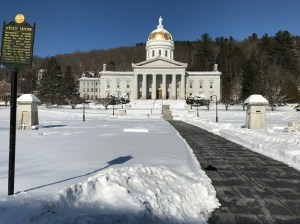
img_0764_editedI have been visiting the Vermont State House in Montpelier this past week. It’s a great place to meet interesting people! Every day brings new people. Wednesday, February 15, for example, featured the annual reception in the State House cafeteria by UVM Extension. There were many people there whom I knew from my career at Yankee Farm Credit, and lots of good food.

In this post, however, I want to tell you about someone else I met at the State House that day: Pastor Pete. This story is both personal and related to a theme of this blog – government and citizenship.

Continue reading

Posted in General | Tagged | 3 Comments

Orange-1 recount: A suggestion

The previous six posts have discussed the recount of the election in the Orange-1 district in the Vermont House of Representatives, and my concerns with the process. In this post I make a suggestion for consideration.

See the report dated January 10, 2017 by the Office of the Attorney General (click here). That report, which I mentioned in an earlier post, discusses when an election issue involving a candidate for the House of Representatives can be resolved by the courts and when it must be resolved by the House of Representatives, taking into account a 1983 decision by the Vermont Supreme Court (Kennedy v. Chittenden). Briefly, the Supreme Court said that a “recount” issue can be resolved by the courts, but a “contest” issue involving certain kinds of alleged irregularities must be resolved by the House of Representatives because of the separation of powers doctrine.

Senior Assistant Attorney General Michael Duane, the author of said report, believes that one aspect of Susan Hatch Davis’s complaint falls into the category of a “contest” issue that requires resolution by the House of Representative – Ms. Davis’s request that all ballots deemed spoiled or defective in the original count be included in a recount. They were not included in either the original count on November 8, 2016 or the recount on November 28.

In fact, the House of Representatives dealt with that issue on February 1, 2017 when it adopted H.R. 8. As proposed, the first resolved clause of H.R. 8 was as follows:

That this legislative body resolves that a recount of all votes cast for the House of Representatives in District Orange-1, except for 14 ballots previously determined to be defective, shall be conducted, and be it further

Representative Haas of Rochester offered the following amendment:

In the first resolved clause by striking out “, except for 14 ballots previously determined to be defective,” and after the words “shall be conducted, and” by inserting “all ballots shall be inspected, and

That proposed amendment was defeated by a vote of 11 yeas to 125 nays with 1 abstention. See the House Journal for February 1, 2017, pp. 138-140 (click here).

I offer the suggestion that the House of Representatives can consider itself to have responded satisfactorily to the issue that it needed to respond to, and that it need take no further action (except to rescind its self-imposed obligation to conduct a recount). I see no need for the House to conduct a recount. The remaining issues are “recount” issues which can be resolved by the courts. In other words, Ms. Davis can now appeal the decision of the Orange County Superior Court to the Vermont Supreme Court if she wishes.

Posted in General | Tagged | Leave a comment

Orange-1 recount: My view

In the previous five posts I discussed the facts in the case of the Orange-1 recount, and four issues that I see in this matter.

Elections are often not as perfect as one would like. The important thing is to come to a decision, relatively quickly, via a process that the vast majority can trust.

The election in the Orange-1 district was good enough for Judge Mary Miles Teachout. It was good enough for Secretary of State James Condos. Susan Hatch Davis was entitled to appeal to the House of Representatives, but in my viewconsidering the previous two sentencesthe House should have denied that appeal.

Ms. Davis alleged numerous irregularities in the government machinery for conducting elections, but did not offer evidence sufficient for Judge Teachout or Secretary Condos to believe that the outcome of the election in Orange-1 would have been different. If the House believes that those alleged irregularities warrant investigation so that future elections may be more bulletproof, that is an appropriate task for the Legislature. But I see no reason for granting Ms. Davis’s request for a second recount.

Regarding the conduct of the executive branch of government in this matter (Issue 3), I wish that the report of the Office of the Attorney General had included an investigation and analysis of the facts, instead of leaving that job to the House of Representatives. I would prefer to use staff time instead of legislator time whenever possible and appropriate. Additionally, the Office of the Attorney General is experienced in conducting investigations. The House Committee on Government Operations interviewed witnesses including the town clerks of the six towns in Orange-1, but did not interview officials involved in the recount on November 28. As a result the committee may have had incomplete information. The two town clerks involved in the recount issued a memo to that effect on February 6, 2017 (click here).

Regarding the conduct of the legislative branch of government in this matter (Issue 4), I am concerned about the direction that this recount takes us. Extensive government machinery exists to conduct elections. The House of Representatives has said by its actions (passing H.R. 8) that it does not trust that machinery and that the only solution in this instance is a recount by legislators. This is worrisome for three reasons.

First, it casts doubt on the entire machinery of elections. The Vermont Municipal Clerks’ and Treasurers’ Association (VMCTA) issued a press release on January 31, 2017 that begins as follows:

The Vermont Municipal Clerks’ and Treasurers’ Association firmly believes recounting the Orange 1 District undermines the integrity of all Town and City Clerks as well as the Justices of the Peace, that are elected to serve as the Board of Civil Authority (BCA).

Click here for the full press release. Even if the House of Representatives did not intend to question the integrity of our institutions, that is how their actions are being perceived, as evidenced by this press release.

Of course, no process is perfect and all parties should strive for continuous improvement, but on a going forward basis – without a second recount by legislators. See comments above.

The second reason this matter is worrisome is that it sets a precedent for the future. The present actions of the House will encourage more losing candidates to file appeals to the House, further weakening trust in our institutions involved in elections. This is also recognized in the VMCTA press release.

Third, it is worrisome that legislators themselves will be counting ballots. Representatives, regardless of party, have an unavoidable conflict of interest when it comes to counting ballots in the election of a peer. No one is going to trust an election process run by representatives more than they trust a process run by trained town clerks who do not have that conflict of interest.

In my career in business, I was involved in the policies and procedures (“machinery”) for electing directors of a farmers’ cooperative—a corporation that was a financial institution and subject to federal regulation. What the House is doing in counting ballots itself is analogous to the directors counting ballots in director elections. That was absolutely prohibited by the federal regulator. It would have been considered unthinkable. And yet the board of directors of a corporation is responsible for judging the qualifications and elections of its directors, analogous to how the Vermont Constitution requires the House of Representatives to judge the elections and qualifications of its representatives. Corporations meet that responsibility by creating policies and procedures for the conduct of director elections that keep sitting directors completely out of the process of counting votes, as required by federal regulation. The House should do likewise.

Presumably the House of Representatives wishes to increase the confidence that citizens have in elections. In my view the House’s actions in the matter of the Orange-1 recount will have the opposite effect.


Posted in General | Tagged | Leave a comment

Orange-1 recount: Issue 4

The fourth issue in the Orange-1 recount is whether or not the legislative branch of Vermont government is properly doing its job in this matter.

The Vermont Constitution says that the House of Representatives “shall have power to … judge of the elections and qualifications of their own members…”

No one expects the House of Representatives to actually conduct the elections of its members. We expect the Legislature to create the machinery of government that is necessary to fairly conduct all elections; to inquire as needed into the operation of that machinery; and to make adjustments to that machinery as circumstances warrant.

The Legislature has created considerable government machinery for elections. Title 17 of Vermont Statutes Annotated (V.S.A.) is about elections. Chapter 51 in that title is about the conduct of elections. Subchapter 9 is about recounts and contest of elections. The section that I quoted in the previous post (17 V.S.A. § 2605) is in Subchapter 9.

The Legislature has delegated operational oversight of elections to the Office of the Secretary of State which has developed substantial procedural manuals and training for those persons who are locally responsible for conducting elections. In towns such as in the present matter, those persons are primarily the town clerk assisted by the selectboard and the justices of the peace (i.e., the Board of Civil Authority). There is also occasional judicial oversight, as in the present matter.

Taken altogether, there is substantial government machinery involved in elections.

Susan Hatch Davis believes that this machinery did not operate properly in the Orange-1 election. The House of Representatives, by passing H.R. 8, agreed. However, there is nothing in H.R. 8 that says what it is about the machinery that did not operate properly. There is nothing about what is wrong with the machinery that is being fixed so that it will not happen again. H.R. 8 seems to say simply that Ms. Davis petitioned the House of Representatives for a recount, and the House believes that the constitutional language quoted above compels them to grant her request. This seems questionable.

Further, the House believes that the only resolution for this matter is to recount the ballots themselves. This is highly unusual. It has not happened since 1985. It is questionable if representatives should ever count ballots in the election of their peers. Historical precedent is important, but it does not guarantee that it was the right thing to do even then. Representatives are generally not trained in election procedures, and counting ballots is not what voters elect representatives to do. But the biggest issue is that there is a huge, built-in, unavoidable conflict of interest. The House seems to believe that the constitutional language quoted above forces them into having to count ballots. This seems questionable.

The issue: Is the House of Representatives properly doing its job as specified by the Vermont Constitution?

Posted in General | Tagged | Leave a comment

Orange-1 recount: Issue 3

The third issue in the Orange-1 recount is whether or not the executive branch of Vermont government is properly doing its job in this matter.

The Office of the Secretary of State plays a major role in overseeing elections. In addition, in the instance where “a candidate for the office of representative to the general assembly in the general election … [requests] the house of representatives to exercise its constitutional authority to judge of the elections and qualifications of its own members,” as Susan Hatch Davis did in this instance, Vermont law provides a role for the Office of the Attorney General:

the attorney general … shall investigate the facts, take such depositions as may be necessary, prepare an opinion on the law and facts, and send his or her report and opinion to the secretary of state…

Both of the above quotes are from 17 V.S.A. § 2605.

I find no issues with the work of the Office of the Secretary of State in this matter. From everything I have seen, their work is exemplary and Vermonters should be proud.

The Office of the Attorney General completed a report dated January 10, 2017 that responded to the requirement in 17 V.S.A. § 2605. That report can be found here.

The report of the Office of the Attorney General is an excellent discussion of the law. I found this report useful in understanding the current matter, and I will come back to this report in a subsequent post. In this post my issue is that the Office of the Attorney General did no investigation of the facts, took no depositions, and prepared no opinion on the facts. This put the burden on the House of Representatives to investigate the facts.

The issue: Does the report of the Office of the Attorney General adequately respond to the requirements of Vermont law?

Posted in General | Tagged | Leave a comment