
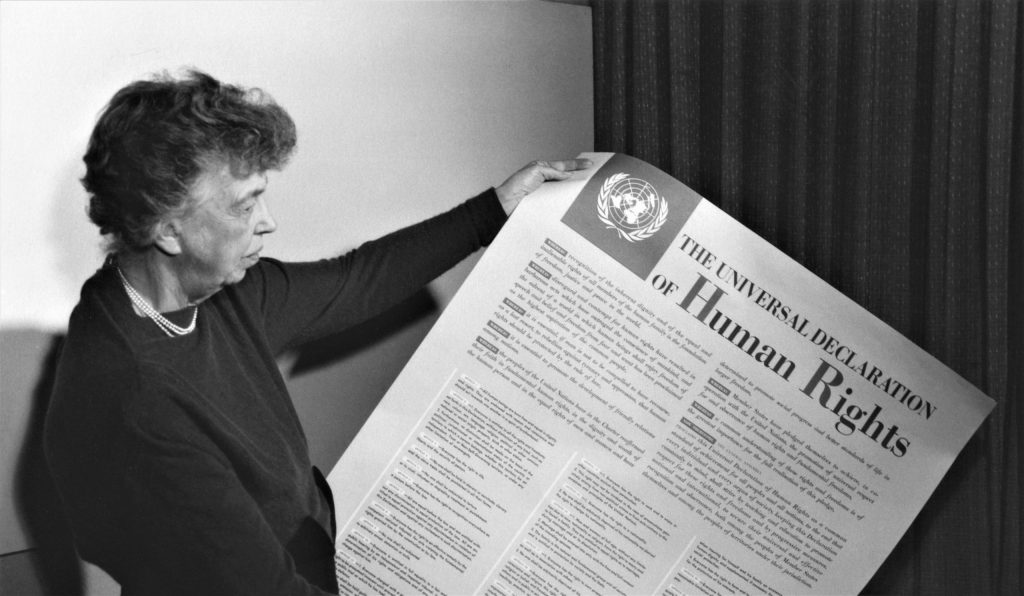
Today is the 75th anniversary of the adoption of the Universal Declaration of Human Rights by the United Nations General Assembly.
Eleanor Roosevelt (pictured) chaired the committee that drafted this important document.
In the Wall Street Journal, Mary Ann Glendon writes:
There’s Life Yet in the Universal Declaration of Human Rights
From its adoption in 1948 to the fall of the Berlin Wall in 1989:
The Universal Declaration became the most prominent symbol of the great grassroots movements that hastened the demise of colonialism, brought down apartheid in South Africa, and helped topple the seemingly indestructible totalitarian regimes in Eastern Europe.
Might the principles in the Universal Declaration guide us in today’s troubled world? Ms. Glendon, a professor of law emerita at Harvard Law School, thinks so. The subhead on the article is:
In the face of war and atrocities, the principles of the 75-year-old document remain sound.
Ms. Glendon cites the following hopeful development in the world outside the United States:
The Center for Shared Civilizational Values, founded by the Indonesia-based Nahdlatul Ulama, wants to build a movement to strengthen a rules-based international order grounded in universal principles. Joining in that endeavor is the world’s largest network of political parties, Centrist Democrat International, composed mostly of European and Latin American political parties. In 2020 both organizations called for renewed global support of the human-rights principles in the Universal Declaration.
Nahdlatul Ulama is Islamic. Centrist Democrat International is Christian.
Mary Ann Glendon did not mention Eleanor Roosevelt in her commentary about the Universal Declaration, but it would not have been adopted in its current form without Ms. Roosevelt’s leadership. I wrote about that in Legacy of the Four Freedoms. The “Four Freedoms” were promoted by President Franklin Roosevelt during World War II. He died shortly before the war ended in 1945, but Eleanor, his widow, ensured that the Four Freedoms were incorporated into the Universal Declaration of Human Rights of 1948.
Here is another scholar writing today, on the occasion of the 75th anniversary of its adoption, about the importance of the Universal Declaration of Human Rights:
Though not legally binding, the UDHR would become a transformational document and the conceptual North Star for the modern human-rights movement.
Source: When the United Nations Actually Stood for Something Good
This article does mention the critical role of Eleanor Roosevelt – and the evolution of her views about the Soviet Union, a partner in winning World War II, based on its behavior following the end of the war:
Speaking at the Sorbonne in Paris in September 1948, Mrs. Roosevelt admitted that Moscow’s failure to respect human rights had become a major obstacle to world peace.
I believe there is a lesson here for today’s world: The key to wider adoption of the principles in the Universal Declaration of Human Rights is to resist authoritarianism.
 The Switchel Philosopher